
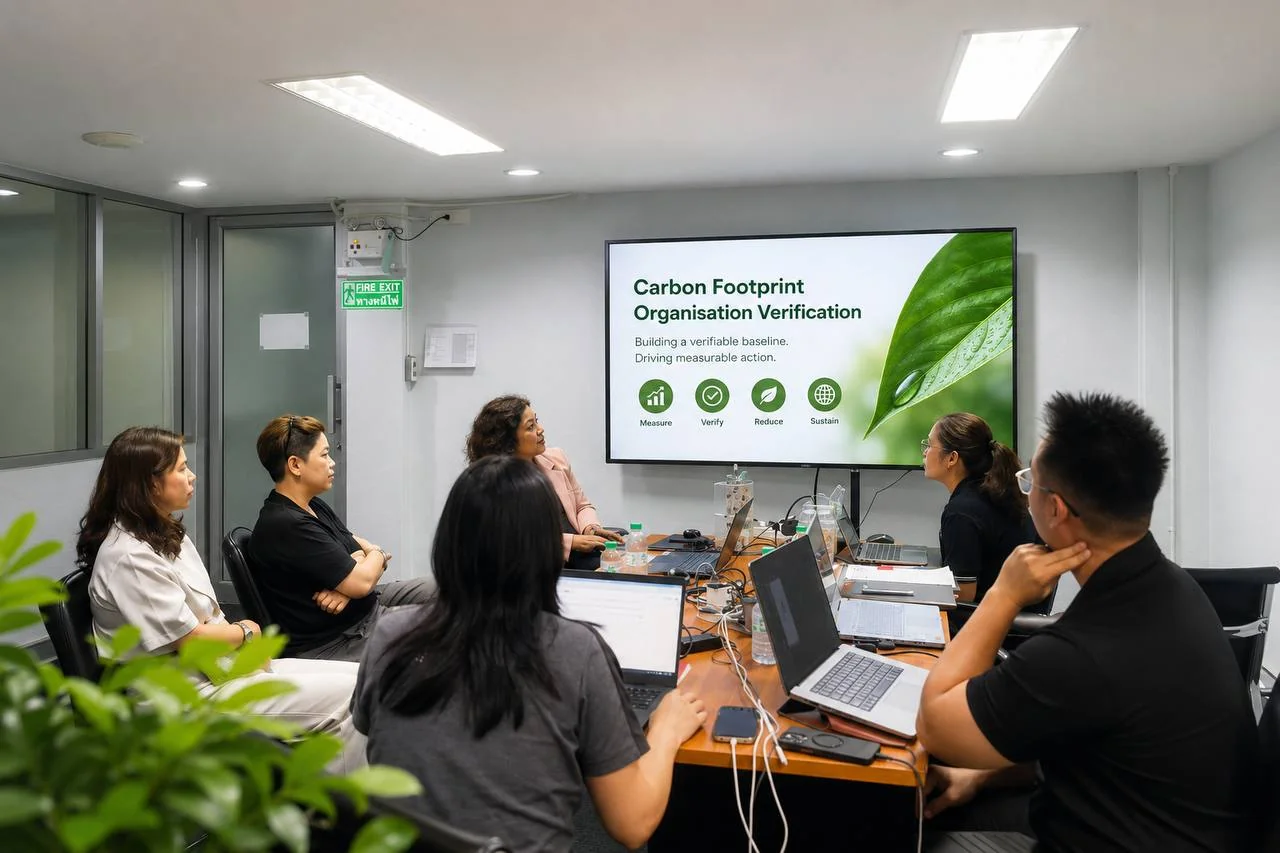
Amanda Jewellery has successfully completed third-party verification of its Carbon Footprint for Organisation (CFO) for the 2025 reporting period, covering 1 January to 31 December 2025. The verified inventory establishes 2025 as Amanda's baseline year for greenhouse gas reporting and performance tracking in the years ahead.
The verification was conducted by BSI Group (Thailand) Co., Ltd. under the Carbon Footprint for Organisation programme of the Thailand Greenhouse Gas Management Organization (TGO), using IPCC AR5 global warming potentials. The verified results are now being submitted to TGO for certification, and the official certificate is expected in November 2026.
What was measured
The inventory covers the twelve-month period from 1 January to 31 December 2025 and reports emissions in tonnes of carbon dioxide equivalent (tCO2e):
| Scope | tCO2e |
|---|---|
| Scope 1 — direct emissions | 7 |
| Scope 2 — purchased electricity | 91 |
| Total Scope 1 and 2 | 98 |
| Scope 3 — fuel- and energy-related activities | 17 |
| Total including this Scope 3 category | 115 |
The distribution is unambiguous. Purchased electricity accounts for approximately 93 per cent of Amanda's Scope 1 and 2 emissions — 190,946 kWh across the year. Direct emissions are comparatively small and arise from LPG, methanol, the recovery of gold from workshop materials, company vehicles, and methane from the site's wastewater system.
That concentration matters, because it tells us precisely where reduction effort belongs. For a manufacturer of Amanda's type, decarbonisation is not a diffuse problem spread across dozens of activities; it is overwhelmingly a question of how much electricity the atelier consumes, and where that electricity comes from. Energy efficiency in casting, polishing, air conditioning and compressed air, together with cleaner sourcing of power, will do the great majority of the work.
Independent assessment
As part of the same programme, the auditor carried out a readiness assessment for certification — an internal evaluation requested by the Gem and Jewelry Institute of Thailand (GIT). Amanda Jewellery scored 97 out of 100, the highest result among the ten participating companies.
The project was supported throughout by GIT, which provided technical consultancy under its initiative to elevate Thailand as a sustainable global hub for gem and jewellery trade and manufacturing.
What comes next
As a member of the Watch & Jewellery Initiative 2030, Amanda Jewellery has committed to signing and submitting a Commitment Letter to the Science Based Targets initiative (SBTi). Signing is the straightforward part. Meeting validated science-based reduction targets within the required timeframe is considerably harder, and a number of companies across many industries have failed to do so and been removed from the SBTi register as a result. Amanda intends to be measured against the outcome rather than the announcement, and the verified 2025 baseline is what makes that measurement possible.
Why we do this work
Today our clients and the global brands we manufacture for are assessed not only on the quality of their products, but on the credibility of their environmental and social practices — and increasingly, so are we. A verified footprint is not a marketing exercise. It is an audited number that our partners can rely on in their own reporting, and a foundation for reductions that can be demonstrated rather than claimed.
For the brands who trust us with their manufacturing, that reliability is part of the service. For us, it reflects a longer view of what a manufacturing business should be accountable for.